Posts

THALICTRUM AQUILEGIFOLIUM (MEADOW RUE)

Image
The Thalictrum 'aquilegifolium' (Meadow Rue) which I planted in 2014 and which I moved to a new position in 2015, has taken off.  It's a beautiful plant with interesting leaves and fabulous flowers but it has to be noted that it is quite tall (about 90cm, 3ft), which means that it can cause some shade on any plant behind it.  Ironically, I moved it last year because it was getting swamped by other plants, and this year it is casting some shade on plants around it.  Don't misunderstand me though, it's not a dense plant, so is not causing heavy shade.  I do recommend growing it, it's quite lovely and goes very well near the chives which are in flower at the moment.  It is also going well with my clematis 'Dr Ruppel'  also in flower right now. Thalictrum 'aquilegiifolium' (Meadow Rue) If I had realised how tall it could get, I would have staked it, I should have staked it, and still will.  Now the wind has gone and blown it over....

WHITE CHRYSANTHEMUM 'SNOWLAND'

Image
When I bought and planted my border edging of the compact  lobelia 'Crystal Palace' the other week, I also bought a couple of trays of the white chrysanthemum called 'Snowland'.  It's a low-growing hardy annual and, like the lobelia, I just want it temporarily until I can put in more permanent plants, like perennials.  At first I was rather disappointed with Snowland as something is getting at the white petals.  I cannot see slugs, or signs of slugs, but I imagine they are what are nibbling at the petals.  Anyway, that problem seems to be easing off and now lovely white daisies, only about 2" (5cm) in diameter are attracting attention here and there along the borders of the lawn.  Chrysanthemum 'Snowland' The label says: Chrysanthemum 'Snowland' has masses of bright white daisy-like flowers covering a mounded plant throughout summer.  It is perfect for beds, borders, and containers.  It achieves a height of  30cm (12") and should...

WHITE CLEMATIS 'GILLIAN BLADES'

Image
I planted the white clematis 'Gillian Blades' in May 2014 and it is doing well.  I just love the crimped edges to her petals, and the flowers are much larger than they appear in the below image.  I have this climber growing on a more or less south-facing fence but its feet (roots) are in the cool shade of perennials and it makes sure itself that it has its 'head' in the sun by clambering up my summer-flowering  white Jasminum officinale and clinging onto the pink  David Austin climber 'Generous Gardener' .  White clematis 'Gillian Blades' - 2016 Sadly, I have had to say goodbye to the white clematis, Arctic Queen' .  I suspect my neglect of her over winter did her in!  Arctic Queen was growing in a terracotta pot on my front porch which is rather exposed to the elements in winter.  I moved the pot to a sheltered corner against my home's back wall, however, with the torrential rain we have been having I hadn't realised that the pot ...

A BORDER EDGING OF COMPACT LOBELIA 'CRYSTAL PALACE'

Image
Once again I have turned over the edges of my ever-shrinking lawn, increasing the size of my borders.  While a lawn is lovely, I want to be able to grow more things in my small garden.  Where I turned the turf over, with the grass facing down, I need to give it time for the grass to rot into the soil before I can plant anything of any depth.  So, for the time being, I have chosen to plant an edging on either side of a compact, non-trailing, annual lobelia: Crystal Palace.  The flowers are a lovely deep blue but not so deep that they don't dazzle along the edge of the lawn.  So pretty they are.  'Crystal Palace', a compact lobelia The label says: Lobelia Compact 'Crystal Palace' has dark blue flowers set against bronze leaves.  It has a vigorous but compact habit and can be used in beds, borders, and pots.  It flowers from summer to autumn, achieving a height and spread of about 10-15cm (4-6").  Plant in sun or partial shade in mod...

BACTERIAL DISEASE ON PRUNUS AVIUM 'STELLA'

Image
Sadly, after growing my lovely Prunus avium 'Stella' cherry tree for three years it has contracted a bacterial disease (identified by the Royal Horticultural Society) in a place that makes it difficult, if not impossible, to cure or control.  There is no (legal) spray for such a disease in the U.K. as such chemicals have been banned by the E.U.   My tree (as luck would have it) has developed the bacteria in the crook of the tree, right at the top of the trunk where the branches fork out.  Although attempts can be made to cut out such diseases, to cut out the disease on my tree would compromise the stability of the surrounding branches.  You can see the orange/brown gum exuded in the image below.  The first time I spotted the disease, however, there was a mass of bright orange at the infection sight.  I should have taken a photograph of it.  Sorry. Bacterial disease on Prunus avium 'Stella' revealing itself in the dischar...

CORONET 'FAMILY' MINIATURE TREE

Image
In May I bought a miniature 'family' apple tree by Coronet .  'Family' means that it has two types of apple on it.  In the case of my small tree it is James Grieve grafted onto the top of Cox's Pippin.  Now that the beautiful flowers have gone, many small apples have appeared.  James Grieve 'baby' apples 21062016 on Coronet 'Family' miniature apple tree

JAPANESE MAPLE - ACER PALMATUM 'KATSURA'

Image
I think the best gardeners must be those who are willing to persevere.  After all, it can be quite tough at times watching beloved plants succumb to pests, diseases, the weather, and ignorance of what they want (killing them with neglect or kindness).  Although vine weevils killed off a lovely Japanese maple 'Orange Dream' of mine, I haven't given up on the idea of growing one of my favourite types of shrubs.  After all, the Acer palmatum dissectum 'Ornatum' that I grow is doing pretty well (so far!).  The other day I bought another addition to my garden family: Acer palmatum 'Katsura'.  It's a Japanese maple that hopefully will not grow too large and will be happy in a container.  It has a delicate growth that's pretty and will be colourful at times.  Acer palmatum 'Katsura' 25 May 2016 Acer palmatum 'Katsura' 25 May 2016 At the moment my plant is tucked up in a sunny and sheltered corner of my garden, facing south-west. ...

ACER PALMATUM DISSECTUM ORNATUM & HOSTAS IN CONTAINERS

Image
Two years ago I planted a Japanese maple, Acer Palmatum dissectum Ornatum', in a terracotta pot and kept it in the shelter of my house wall, facing east.  It has more than survived, it has thrived, despite the dreaded vine weevil larvae destroying a neighbouring Japanese maple, Orange Dream .  I am amazed at how well this delicate-looking shrub has grown in such a relatively short period of time.  Acer Palmatum dissectum Ornatum' and hostas (left to right) Sagai, Patriot, and Brimcup -  25 May 2016 Some plants that are in containers are more vulnerable in winter when the low temperature can freeze their roots.  I think that having a cluster of containers around the maple has protected it.  My acer is surrounded by terracotta-container grown hostas all winter.  I believe that terracotta pots are more protective temperature-wise than plastic.  In seriously low temperatures, I throw bubble-wrap and garden-fleece over them.  I read...

MINIATURE APPLE TREE - JAMES GRIEVE & COX'S ORANGE PIPPIN

Image
I bought a new addition to my fruit and vegetable garden today: an apple tree.  My garden is quite small (with a lot in it!) and so I had to buy a miniature, or dwarf, apple tree and I got the sort that has two kinds of apples on it.  My choice was Coronet 'Family' James Grieve and Coxs Orange Pippin.  The truth is, I'm not so bothered about having the apples as I am about having the blossoms.  I love trees and the compromise for having such a small garden (about 22ft x 22ft) is to downsize.  Every shrub or climber that I select is chosen because it has limited growth.  Coronet 'Family' apple tree, James Grieve and Coxs Orange Pippin 24052016 I've chosen to keep mine in a container on the top patio where it will get full sun but be protected somewhat from wind.  I've potted it into a heavy terracotta container that is about 38cm dia, using a multi-purpose compost, and I've staked it (I just tied two strong bamboo canes together to us...

HOSTA 'REVERSED PATRIOT' OR 'REVERSE PATRIOT' AKA 'FIRE AND ICE'

Image
I keep adding to my little collection of hostas which seems like a good idea at the time but as I grow them in large containers on wheels, they do take up a bit of patio space.  I saw this little 'Reversed Patriot' (or Reverse Patriot), also known as Fire and Ice, and I had to have it.  The regular Patriot is a fabulous hosta with beautiful lily-like flowers and I can only image that this will be just as beautiful in maturity, but with a reverse pattern on its leaves.  A young Hosta 'Reversed Patriot' 23052016 A young Hosta 'Reversed Patriot' 23052016 The label says that 'Reversed Patriot' hosta is an excellent clump-forming plant with lavender-blue flowers in summer over variegated foliage that have dark green margins and pure white midribs.  The dense growth helps to suppress weeds.  It re-grows from ground level every year.   It achieves a heigh of 60cm (2ft) and spread of 1 metre (3ft).  It likes well-drained, moist soil in light ...

SYRINGA VULGARIS 'ANDENKEN AN LUDWIG SPATH'

Image
I bought a pretty lilac the other day: Syringa vulgaris 'Andenken an Ludwig Spath'.  What a name!  I'm trying to form a bit of a screen above my 6ft south-facing fence in the hope of cutting any noise down from a neighbouring property.  The neighbour has erected a budgie aviary right next to the fence.  Sadly, pretty though they are, budgies screech and squawk, not twitter.  I've already planted Syringa vulgaris 'Madame Lemoine', a white double lilac and next to it a Buddleja davidii 'Empire Blue'.  I now simply have to wait for them to grow and close ranks.  I plan to control their growth, height and width, by selective pruning.  That's the plan anyway. Syringa vulgaris 'Andenken an Ludwig Spath' in bud 22052016 Syringa vulgaris 'Andenken an Ludwig Spath' has been awarded the Royal Horticultural Society 'Award of Garden Merit'  (external link).  It is a fully hardy, deciduous lilac with an exceptionally lav...

VICTORIA LADY FERN (ATHRIUM FILIX FEMINA VICTORIAE)

Image
This little gem of a fern, Victoria Lady Fern (Athyrium filix femina Victoriae), is quite small at the moment and is planted in a terracotta pot which is hidden from strong sun by my Japanese maple, Acer palmatum dissectum Ornatum .  The fern is the brightest of greens and has really eye-catching fronds.   Victoria Lady Fern (Athyrium filix femina Victoriae) 16052016 The label says that Victoria Lady Fern (Athyrium filix femina Victoriae) is a delightful fern with very unusual green fronds through the growing season.  It is perfect for moist, shady corners or well-watered patio tubs in shade.  It is a hardy perennial and non- evergreen.  It achieves a height of 45cm (18in) and spread of 50cm (20in).  It likes dappled shade with shelter from strong winds in a moist, fertile, preferably acid soil. 

BRAUN'S HOLLY FERN (POLYSTICHUM BRAUNII)

Image
This Braun's Holly Fern (Polystichum braunii) is one of  three ferns ( Buckler Fern , Wood Fern ) that I have planted at the lower end of a sloping border which faces south-east.  It gets a few hours of any morning sun and then it is in some shade.  Some wind protection is provided by the tall fence on the immediate north side of the ferns.  Braun's Holly Fern (Polystichum braunii) 16052016 The label says that Braun's Holly Fern (Polystichum braunii) produces lovely elegant fresh green fronds that add all year appeal to any garden.  It achieves a height of 70cm (28in) and a spread of 60cm (24in).  It likes partial shade with shelter from strong winds, and good, moisture-retentive soil or compost. 

BUCKLER FERN - DRYOPTERIS ATRATA

Image
The Buckler Fern (Dryopteris atrata) that I planted the other week seems to be happy enough in its position at the lower part of my sloping border.  There it receives partial shade and moist soil.  It's pushed up some young fronds which is always a good sign.  Buckler Fern (Dryopteris atrata) 16052016  Close up of unfurled frond of Buckler Fern (Dryopteris atrata) 16052016 Sex life of ferns  (internal link) The label says that Buckler Fern's (Dryopteris atrata) flat, dark green fronds form a handsome clump which is superb in mixed shady borders.  It can also be grown in a larger patio container placed in some shade.  It is semi-evergreen and perennial. It achieves a height of 40cm (16in) and spread of 50cm (20in).  It likes partial shade with shelter from strong winds and will thrive in any good, moisture-retentive soil.  This plant has the Award of Garden Merit from the Royal Horticultural Society. 

WOOD FERN - THELYPTERIS DECURSIVE PINNATA

Image
I'm very fond of ferns, as I have probably mentioned before, almost as much as I love trees.  I bought a Wood Fern (Thelypteris decursive pinnata) the other week and have planted it near to two others: a Buckler Fern and a Braun's Holly Fern.  They require shade, or partial shade.  Unfortunately, although I have them in a moist spot, at this time of year they will get a fair amount of any sunshine for a few hours in the morning.  Wood Fern (Thelypteris decursive pinnata), 7 May 2016 The label says that Thelypteris decursive pinnata (commonly known as Wood Fern) has long, light-green delicate fronds from spring to autumn.  Useful for mixed borders, patio tubs, or gravel to brighten up shady areas.  It is hardy and perennial; and achieves a height and spread of 60cm (24in).  It likes partial shade with protection from strong winds in any good, moisture-retentive soil. 

BUMBLE BEES LOVE LITHODORA DIFFUSA 'HEAVENLY BLUE'

Image
Although I've seen one or two bees buzzing around my garden for a short while now, now that the weather is warming up, it was a delight to see Bumble Bees enjoying Lithodora diffusa 'Heavenly Blue' on the sunny border at the front of my home.  The sun was shining on the bees, and the flowers strikingly blue.  Note to self: Lithodora diffusa attracts pollinators, and it looks fabulous in the garden. Bumblebee on Lithodora diffusa 'Heavenly Blue' 14052016   Bumblebee on Lithodora diffusa 'Heavenly Blue' 14052016

AJUGA REPTANS 'BRAUNHERZ'

Image
Ajuga reptans 'Braunherz' is a wonderful mat-forming ground-covering plant for the garden.  It has really bronze coloured foliage which spreads along the soil on runners, and spikes of eye-catching purple-blue flowers.  It's a very hardy evergreen perennial which is suitable for a wide range of soil types and tolerates full sun or partial shade according to the Royal Horticultural Society.   I've planted mine in the border at the front of my home where it will get full sun in the afternoon.  Have you noticed, a cheeky little greenfly is having a go at it in the image below.   How dare it! Ajuga reptans 'Braunherz' The label says that Ajuga reptans 'Braunherz' has deep blue flower spikes above carpets of glossy purple-bronze foliage.  It is suitable for borders as ground cover, rockeries, banks and gravel gardens, in sun or partial shade on moist but well-drained soil.  It flowers from mid spring to early summer.  It a...

HELIANTHEMUM 'THE BRIDE' a.k.a. 'SNOW QUEEN'

Image
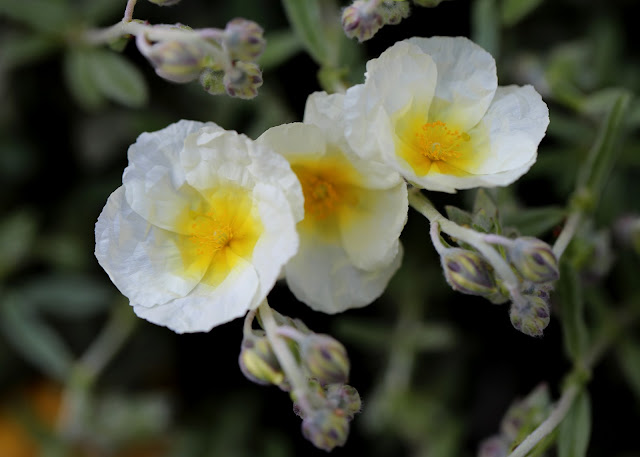
I planted Helianthemum 'The Bride' last year, when it was a quite small plant, at the top of a sloping south-east facing sunny border.  Since then it has spread to about 30cm (12in) diameter and is full of flower buds.  The flowers remind me of poached eggs but when you look closely, the petals are crinkled like silk. The foliage is an interesting grey-green which indicates it likes sunshine.   Helianthemum 'The Bride' The label says that Helianthemum 'The Bride' (also known as Snow Queen) is an evergreen mat forming perennial producing masses of white flowers with a yellow centre over light green foliage.  It is suitable for rockeries, borders, walls, banks, paving, gravel gardens, containers and pots.  It flowers from late spring to early summer.  It achieves a height of 25cm (10in) and spread of 40cm (16in).  It likes full sun or partial shade and free draining soil. According to the Royal Horticultural Society (RHS) it has a hardiness ...

SALVIA NEMOROSA 'OSTFRIESLAND'

Image
I liked this plant, Salvia nemorosa 'Ostfriesland', so much when I saw it at a local garden centre that I bought two.  Although it's nice to see the occasional gaudy flower in a garden, there is nothing that fits so well with other plants than an upright plant with cool grey-green leaves and delicate spikes of non-showy flowers.  Do you know what I mean?  If you don't, take a look at this:  Salvia nemorosa 'Ostfriesland' 12052016 Close up of Salvia nemorosa 'Ostfriesland' 12052016 The label says: This deep purple Salvia nemorosa 'Ostfriesland' flowers from June until September.  Plant in the garden or border in a sunny to semi-shaded position.  Clip the old flower stems back to a leaf for a long flowering period.  It achieves a height of 50cm (20in). I am growing one plant in a south-east position in partial-shade, and the other one in a sunny south-facing aspect. 

ARABIS BLEPHAROPHYLLA 'ROSE DELIGHT'

Image
Arabis blepharophylla 'Rose Delight' is a striking little plant that will catch your eye with its vivid cerise-pink flowers.   Arabis blepharophylla 'Rose Delight' Below, the flowering stalks will soon need to be cut back in the hope of encouraging more flowering stems.        Arabis blepharophylla 'Rose Delight' The label says: Arabis 'Rose Delight' is a pretty, cushion-forming perennial whose evergreen rosettes of foliage offset graceful, fragrant flowers.  It is suitable for rockeries or dry borders in well-drained soil.  It prefers partial shade.  It flowers early summer and achieves a height of 10cm (4in) and spread of 20cm (8in).  It's a hardy plant. The flower stalks of mine is already much higher than 10cm  I'd say about 20cm (8in) at least.

Followers